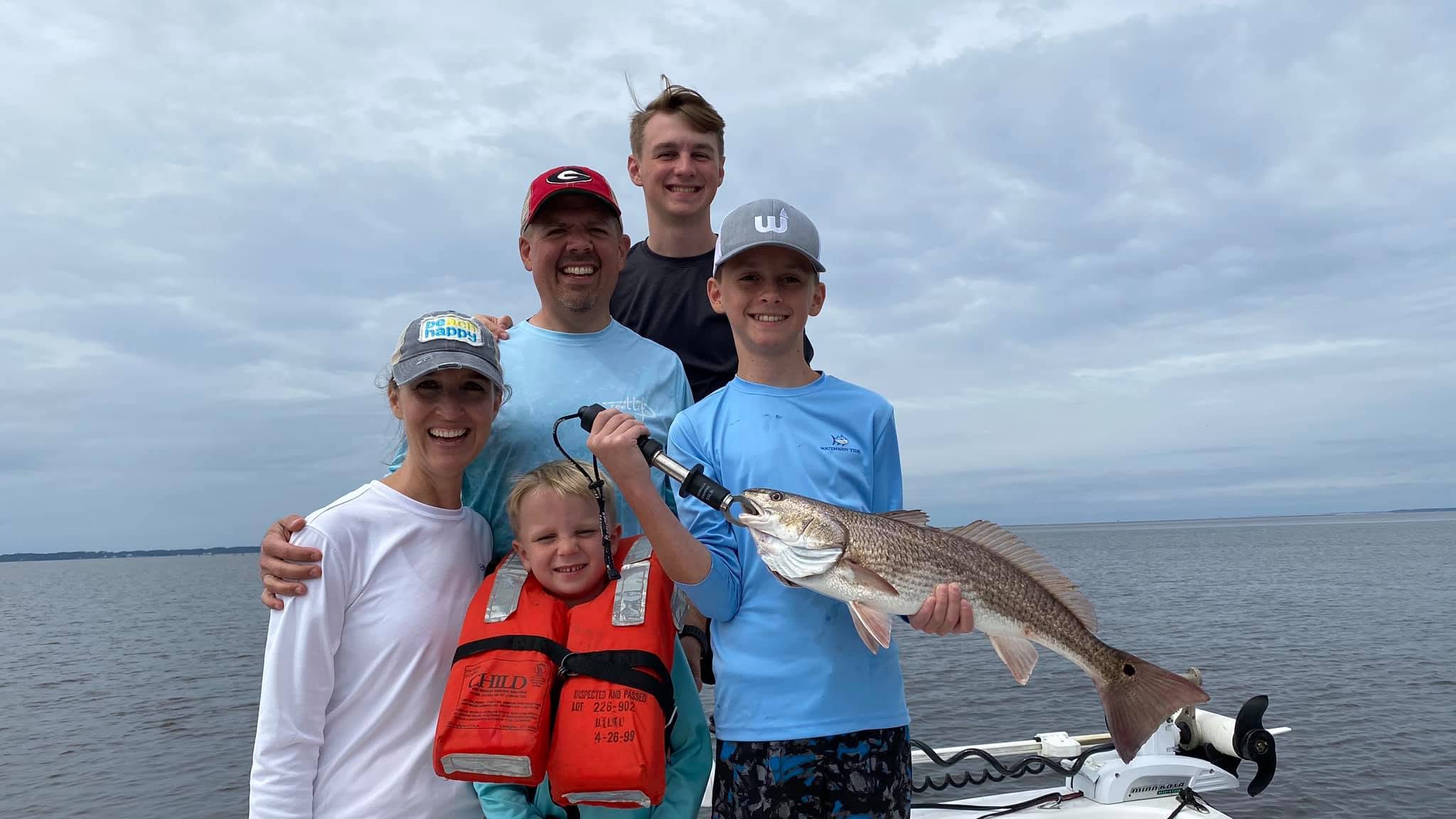

Why Choctawhatchee Bay?
Choctawhatchee Bay is one of Florida’s most productive inshore fisheries — a 174-square-mile estuary stretching from Destin to the east, bordered by the 30A corridor to the south and the Panhandle to the north. Its diverse habitats — seagrass flats, oyster bars, river mouths, bridge structure, and tidal creeks — support an extraordinary variety of species year-round.
Unlike the crowded Destin harbor, Rising Son Expeditions launches from a strategic point that gives us faster access to the quiet, less-pressured North Bay and river mouth areas — where the fish are and the crowds aren’t.
Below is a complete guide to the 8 primary species our guests target throughout the year — including the best seasons, Captain Trey’s proven techniques, and current Florida FWC size and bag limits.
INSHORE
SHALLOW FLATS
YEAR-ROUND
Redfish
Sciaenops ocellatus
Best Season
Year-round
Difficulty
Moderate
The crown jewel of inshore fishing. Redfish (Red Drum) are powerful fighters found in the shallow grass flats and marshes of Choctawhatchee Bay. Known for their signature copper-bronze color and the distinctive black spot near their tail.
DESCRIPTION
The Redfish — or Red Drum — is the crown jewel of Choctawhatchee Bay and the fish most anglers come to Rising Son Expeditions to target. Identified by its copper-bronze scales and the iconic black spot near the tail (nature’s “false eye” to fool predators), Redfish are powerful fighters that will test your drag and your patience. In the bay, we target slot reds (18″–27″) on the grass flats year-round, but fall brings the real spectacle: oversized “Bull” Redfish pushing 30–50 inches that school near the Mid-Bay Bridge and the pass.
Captain Trey’s Technique
Live shrimp under a popping cork on the grass flats is the classic approach. For Bull Reds in the fall, we switch to cut mullet or large soft plastics slow-rolled near structure. Captain Trey reads the water — look for tailing reds in shallow grass, nervous water, or the distinctive bronze flash just below the surface.
FUN FACT
Redfish can live over 40 years and grow to over 90 lbs. The state record in Florida is 52 lbs 5 oz.
FWC Keep Limit
1 per person · 18″–27″ slot
SEAGRASS BEDS
GREAT TABLE FARE
ALL SKILL LEVELS
Speckled Trout
Cynoscion nebulosus
Best Season
Spring & Fall
Difficulty
Beginner Friendly
Speckled Trout (Spotted Sea Trout) are one of the most sought-after inshore species along the Gulf Coast. They inhabit seagrass beds and are prized for both their fight and their table fare. Prime targets in Choctawhatchee Bay.
DESCRIPTION
The Speckled Trout — officially the Spotted Sea Trout — is arguably the most popular inshore target on the Florida Panhandle. Silver-bodied with distinctive black spots along the back and upper sides, yellow-tipped fins, and prominent canine teeth, Specks are aggressive feeders and spectacular on light tackle. They’re one of the best eating fish in the bay, making them a top choice for anglers planning a “Hook and Cook” dinner. Summer mornings on the grass flats and winter deep holes both produce excellent trout fishing.
Captain Trey’s Technique
Topwater plugs at first light during summer are absolutely thrilling — the explosive surface strike is unforgettable. Live shrimp under a popping cork works all year. In winter, slow-sinking lures and jigs worked along deep grass edges and channel drops are the go-to presentation.
FUN FACT
Speckled Trout are highly sensitive to cold water. A hard freeze can cause a “cold stun” event that temporarily incapacitates fish — a natural phenomenon that occurs every few years in the Panhandle.
FWC Keep Limit
3 per person · 15″-19″ minimum
SANDY BOTTOMS
EXCELLENT TABLE FARE
FALL SEASON
FLOUNDER
Paralichthys albigutta
Best Season
Fall Peak
Difficulty
Challenging
Gulf Flounder are masters of camouflage that lurk on sandy bottoms near structure. They’re a prized catch for their delicious white meat. Our captains know exactly where to find these elusive flatfish in the local waters.
DESCRIPTION
The Southern Flounder is one of the most fascinating — and delicious — fish in Choctawhatchee Bay. A master of camouflage, Flounder lie flat on the sandy bottom with both eyes on the same side of their body, ambushing prey that passes overhead. Their white, flaky meat is prized by anglers and chefs alike. The annual Flounder Run in fall is one of the most anticipated fishing events on the Gulf Coast, when large numbers of Flounder migrate through the passes toward the Gulf as water temperatures drop.
Captain Trey’s Technique
Flounder are ambush predators, so presentation is everything. Live finger mullet or mud minnows bounced slowly along the bottom near grass edges, channel drops, and pass entrances are the most effective approach. During the Flounder Run (October–November), Captain Trey targets the pass and Mid-Bay Bridge for the best action.
FUN FACT
Flounder start life as normal-looking fish. As juveniles, one eye migrates to the other side of the head — a process called metamorphosis — transforming them into the flat, bottom-dwelling ambush predators we know.
FWC Keep Limit
5 per person · 14″ minimum
JETTIES
DOCK STRUCTURES
SPRING
SheepsheaD
Archosargus probatocephalus
Best Season
Spring
Difficulty
Advanced
A black-and-white striped fish with strong, human-like teeth designed for crushing barnacles and crustaceans. Sheepshead congregate around bridge pilings, docks, and structure. They are notoriously difficult to hook — hence the saying ‘set the hook before they bite.’ Fiddler crabs are the top bait. A great winter species in the Bay.
DESCRIPTION
The Sheepshead is the fish that humbles experienced anglers. With its bold black-and-white vertical stripes (earning it the nickname “convict fish”) and remarkably human-like teeth — designed for crushing barnacles, oysters, and crustaceans — the Sheepshead is one of the most distinctive and challenging fish in the bay. They’re notorious bait stealers, with a light, subtle bite that requires a hair-trigger hookset. Spring is prime time, when Sheepshead congregate around bridge pilings, jetties, and dock structure.
Captain Trey’s Technique
Fiddler crabs are the gold-standard bait for Sheepshead — they simply can’t resist them. Fresh shrimp and sand fleas also work well. Fish tight to structure: bridge pilings, oyster bars, and dock legs. The key is feeling the subtle “thump” of the bite and setting the hook immediately — hesitate and you’ll come up empty.
FUN FACT
Sheepshead teeth are so similar to human teeth that they’ve been mistaken for human remains in forensic cases. Their molars are perfectly designed for crushing hard-shelled prey.
FWC Keep Limit
8 per person · 12″ minimum
INSHORE
EXCELLENT TABLE FARE
FALL SEASON
Spanish Mackerel
Scomberomorus maculatus
Best Season
Spring & Fall
Difficulty
Beginner
Spanish Mackerel are the speedsters of Choctawhatchee Bay — sleek, iridescent, and blazing fast. Their silver bodies with blue-green backs and distinctive yellow-gold spots make them one of the most beautiful fish in the bay.
DESCRIPTION
Spanish Mackerel are the speedsters of Choctawhatchee Bay — sleek, iridescent, and blazing fast. Their silver bodies with blue-green backs and distinctive yellow-gold spots make them one of the most beautiful fish in the bay. Spanish Mackerel arrive in the Panhandle in spring as water temperatures rise and stay through early summer before moving offshore in the heat. They return again in fall. Known for explosive surface strikes and screaming runs, Spanish Mackerel are a blast on light tackle and are excellent table fare when iced immediately after catch.
Captain Trey’s Technique
Spanish Mackerel are sight feeders that respond well to fast-moving presentations. Trolling small spoons or casting silver Gotcha plugs near surface-feeding schools is the most productive approach. Look for diving birds and surface commotion — that’s where the action is. Wire leader is recommended due to their razor-sharp teeth.
FUN FACT
Spanish Mackerel can swim up to 35 mph in short bursts — one of the fastest fish in inshore waters. Their sharp, serrated teeth can easily cut through monofilament line.
FWC Keep Limit
15 per person · 12″ minimum
SANDY BOTTOMS
BAY PASSES
SPRING
Florida Pompano
Trachinotus carolinus
Best Season
Spring
Difficulty
Moderate
One of the most highly prized table fish in Florida. Pompano are found over sandy bottoms in the Gulf and bay passes, especially in spring and fall. They are fast, strong fighters and command top dollar at restaurants. Catching a pompano is always a treat.
DESCRIPTION
The Florida Pompano is widely considered one of the finest eating fish in the ocean — and one of the most prized catches in Choctawhatchee Bay. With its deep, compressed silver body, golden-yellow belly and fins, and deeply forked tail, Pompano are as beautiful as they are delicious. They arrive in the Panhandle in spring, feeding aggressively along sandy beaches, jetties, and the bay entrance. Pound for pound, Pompano are exceptional fighters on light tackle, and their firm, rich white flesh commands premium prices at restaurants.
Captain Trey’s Technique
Sand fleas (mole crabs) are the classic Pompano bait — they’re irresistible to these fish. Small jigs tipped with shrimp or fished plain also work well. Target sandy bottom areas, jetties, and the bay entrance during incoming tides. Pompano feed close to the bottom, so keep your presentation low.
FUN FACT
Florida Pompano is one of the most expensive fish sold in U.S. seafood markets, sometimes fetching over $20/lb at restaurants. A fresh Pompano dinner is one of the true culinary highlights of the Gulf Coast.
FWC Keep Limit
6 per person · 11″ minimum
INSHORE
HARD BOTTOMS
SUMMER
Mangrove Snapper
Lutjanus griseus
Best Season
Summer
Difficulty
Moderate
The Mangrove Snapper — also called Gray Snapper — is the summer specialist of Choctawhatchee Bay. Reddish-brown to gray with a distinctive dark stripe running from the snout through the eye, are cunning, leader-shy fish that require a finesse approach.
DESCRIPTION
The Mangrove Snapper — also called Gray Snapper — is the summer specialist of Choctawhatchee Bay. Reddish-brown to gray with a distinctive dark stripe running from the snout through the eye, Mangrove Snapper are cunning, leader-shy fish that require a finesse approach. They congregate around dock structure, bridge pilings, and any hard bottom during summer, often in large schools. They’re exceptional eating fish with firm, white, mildly sweet flesh — and they fight hard for their size.
Captain Trey’s Technique
Light fluorocarbon leader is essential — Mangrove Snapper are notoriously line-shy. Live shrimp or small pinfish fished near structure on a light jig head or free-lined is the most effective approach. Fish during low-light periods (early morning, evening) when Snapper move out from structure to feed more aggressively.
FUN FACT
Mangrove Snapper can live over 25 years and grow to over 15 lbs, though most inshore fish are 1–3 lbs. The largest recorded was 17 lbs 4 oz.
FWC Keep Limit
10 per person · 10″ minimum
DEEP BAYOU BOTTOMS
EXCELLENT TABLE FARE
FALL & WINTER
Black Drum
Sciaenops ocellatus
Best Season
Fall & Winter
Difficulty
Moderate
The Black Drum is the gentle giant of Choctawhatchee Bay. Deep-bodied, dark grey to black, with distinctive chin barbels used to feel for food along the bottom, Black Drum are powerful, methodical fighters that can reach impressive sizes — 30+ lbs in the bay is not uncommon.
DESCRIPTION
The Black Drum is the gentle giant of Choctawhatchee Bay. Deep-bodied, dark grey to black, with distinctive chin barbels used to feel for food along the bottom, Black Drum are powerful, methodical fighters that can reach impressive sizes — 30+ lbs in the bay is not uncommon. They’re most active in fall and winter, feeding heavily on oysters, crabs, and shrimp in deep bayous and river mouths. Black Drum are excellent eating at smaller sizes (under 15 lbs), with firm, mild white flesh perfect for blackening or grilling.
Captain Trey’s Technique
Black Drum are bottom feeders, so keep your bait on the bottom. Fresh shrimp, blue crab, and fiddler crabs are top baits. Target oyster bars, bridge structure, and deep channel edges during falling tides. In winter, slow-rolling jigs along deep bayou bottoms and river mouths produces consistent results.
FUN FACT
Black Drum are named for the loud drumming or croaking sound they produce by vibrating their swim bladder — a sound loud enough to be heard from the dock on calm days.
FWC Keep Limit
5 per person · 14″ minimum · 1 over 24″
Seasonal Quick Reference
When to target each species in Choctawhatchee Bay
| Species | Spring | Summer | Fall | Winter |
|---|---|---|---|---|
| Redfish | Available | Available | Peak | Available |
| Speckled Trout | Available | Peak | Available | Peak |
| Flounder | Available | Available | Peak | Not a primary season |
| Sheepshead | Peak | Not a primary season | Available | Available |
| Spanish Mackerel | Peak | Available | Available | Not a primary season |
| Pompano | Peak | Not a primary season | Available | Not a primary season |
| Mangrove Snapper | Available | Peak | Available | Not a primary season |
| Black Drum | Available | Not a primary season | Peak | Peak |
Ready to Target Your Favorite Species?
Captain Trey knows exactly where and when to find every species on this list. Book your inshore charter on Choctawhatchee Bay today — all skill levels welcome.
RELATED BLOG POSTS
Local Knowledge
FROM
Best Fishing Spots on Choctawhatchee Bay
A local captain’s guide to the top inshore locations near Santa Rosa Beach and 30A.
Planning Guide
FROM
Destin vs. 30A Fishing Charters: What’s the Difference?
A local captain’s honest comparison to help you choose the right charter for your trip.
Fishing Report
FROM
June 2026 Fishing Report
What’s biting on Choctawhatchee Bay this month — straight from the captain’s log.