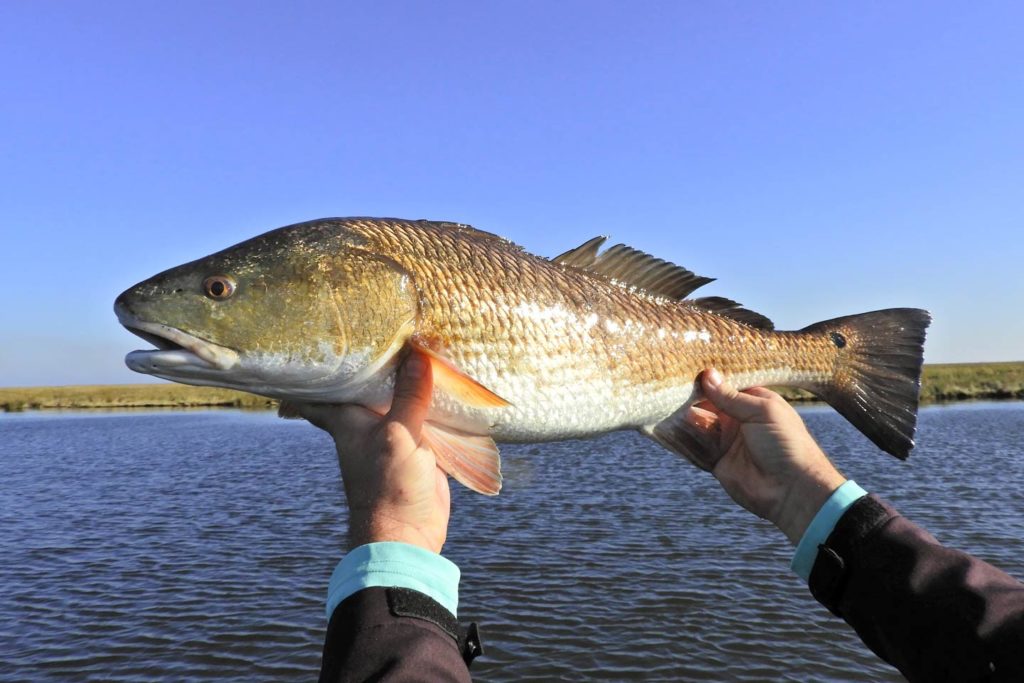

If I had to pick one species that defines inshore fishing on Choctawhatchee Bay, it would be the redfish. I’ve been chasing them on these waters for over 40 years, and they never get old. There’s something about a redfish tailing on a grass flat in the early morning light — the copper flash of the tail, the slow deliberate movement, the anticipation of the cast — that I never tire of.
Redfish (also called red drum or channel bass) are the most sought-after inshore species in the Gulf of Mexico, and Choctawhatchee Bay is one of the best places in Florida to catch them. This guide covers everything you need to know — from identification and habitat to seasonal patterns, techniques, and regulations.
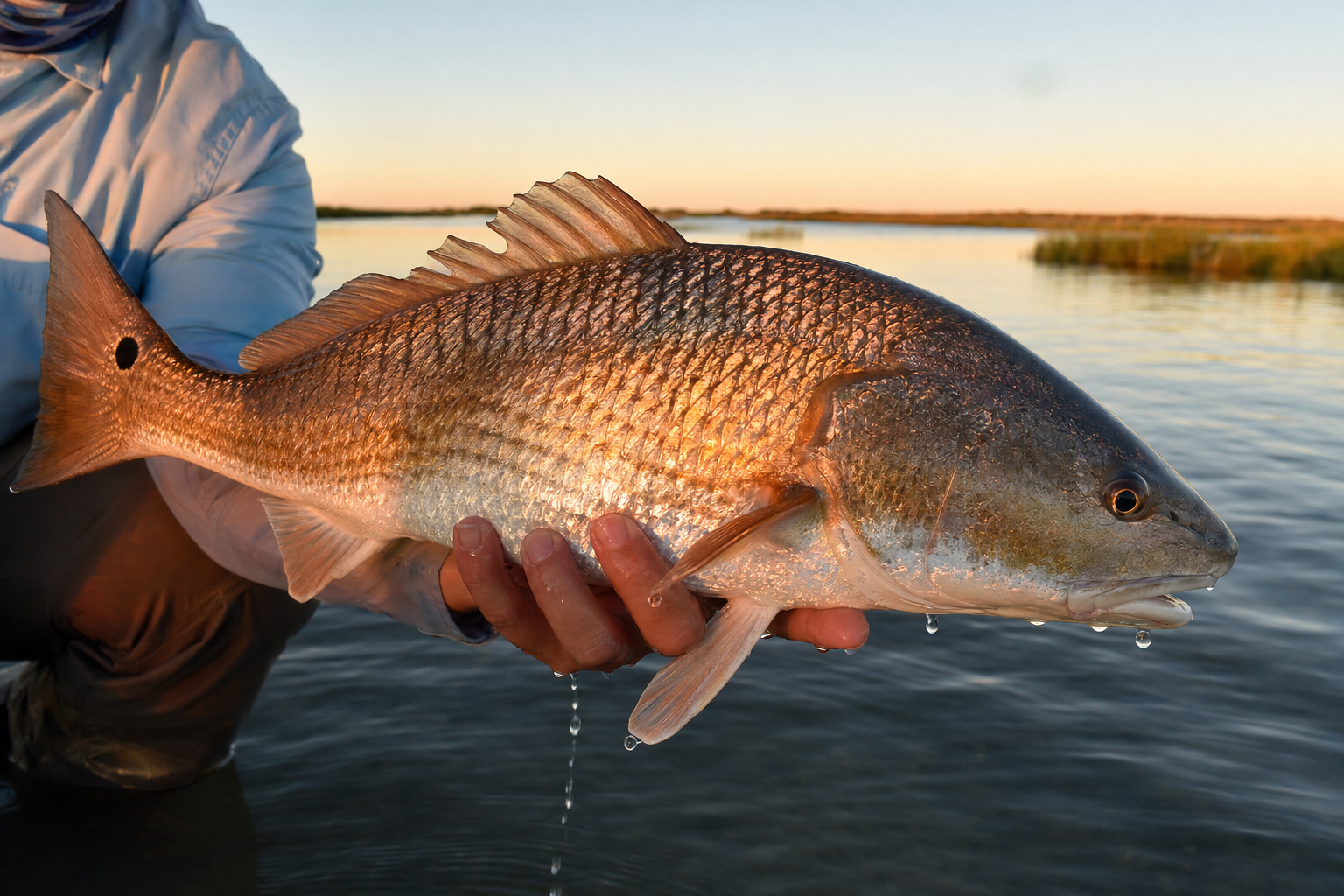
A slot-size redfish from the grass flats of Choctawhatchee Bay — the copper-bronze coloring and black tail spot are unmistakable.
Identifying Redfish
Redfish are hard to mistake once you’ve seen one. Their copper-bronze to reddish-brown coloring — which gives them their common name — is distinctive, particularly in the sunlight. The back and sides range from bright copper to dark reddish-brown depending on water clarity and habitat, fading to a white or silver belly.
The most distinctive feature is the black spot (or spots) near the base of the tail. Most fish have one spot, but it’s not uncommon to see fish with two, three, or even a dozen spots. Biologists believe the spots may serve as a false eye to confuse predators attacking from behind.dfish are hard to mistake once you’ve seen one. Their copper-bronze to reddish-brown coloring — which gives them their common name — is distinctive, particularly in the sunlight. The back and sides range from bright copper to dark reddish-brown depending on water clarity and habitat, fading to a white or silver belly.
Habitat: Where Redfish Live in Choctawatchee Bay
Redfish are a shallow-water species. In Choctawhatchee Bay, they spend most of their time in water between 1 and 5 feet deep, moving with the tides across grass flats, oyster bars, and tidal creeks. They’re a structure-oriented fish — they use grass, oyster reefs, and mangrove edges as both cover and hunting grounds.
The best redfish habitat in Choctawhatchee Bay includes the extensive grass flats near the Mid-Bay Bridge, the oyster bars along the north shore near Niceville and Bluewater Bay, and the tidal creeks and bayous that drain into the bay from the north. The East Pass area, where the bay meets the Gulf, also holds good numbers of fish, particularly in the fall.
Juvenile redfish (under 18 inches) tend to school in large groups in the shallower areas of the bay. Adult slot fish (18–27 inches) are more solitary or in small groups of 2–5 fish. Oversized “bull reds” (over 27 inches) are typically found in deeper water near the passes and along the Gulf beaches, particularly in the fall when they spawn.
Seasonal Patterns
| Season | Water Temp | Where to Find Them | Best Technique |
|---|---|---|---|
| Spring (Mar–May) | 60–75°F | Grass flats, oyster bars — actively feeding | Live shrimp, gold spoon, topwater |
| Summer (Jun–Aug) | 80–88°F | Early morning on flats; midday near structure | Live shrimp at dawn; soft plastics near shade |
| Fall (Sep–Nov) | 65–80°F | Flats, East Pass, near spawning aggregations | Live mullet, cut bait, gold spoon |
| Winter (Dec–Feb) | 50–65°F | Deeper holes, creek mouths, warmer pockets | Slow-worked soft plastics, live shrimp |
Best Baits and Techniques
Live Bait
Live Shrimp is the most consistently productive bait for redfish in Choctawhatchee Bay year-round. Rigged on a 1/0 or 2/0 circle hook under a popping cork in shallow water, or free-lined on a light leader in deeper water, live shrimp will catch redfish in any season and any condition.
Live finger mullet is the preferred bait during the fall, particularly when targeting larger fish. Mullet are the primary forage fish in the bay during the fall migration, and redfish key in on them heavily. A live finger mullet free-lined or rigged under a float near the East Pass in October is one of the most effective redfish presentations I know.
Artificial Lures
Gold spoon: The classic redfish lure. A 1/2 oz gold Johnson Silver Minnow worked slowly across the grass flats is one of the most effective redfish presentations ever developed. The wobbling flash mimics a fleeing baitfish and triggers aggressive strikes. Work it slowly enough to stay just above the grass — too fast and it rises out of the strike zone.
Soft plastic paddle tails: White, chartreuse, or gold paddle tails on a 1/4 oz jig head are versatile and effective year-round. Work them slowly along the bottom near grass edges and oyster bars. The DOA Shrimp and the Gulp! Shrimp are particularly effective for redfish.
Topwater plugs: Early morning topwater fishing for redfish is one of the most exciting experiences in inshore fishing. A Heddon Spook or similar walking bait worked over the grass flats at first light will draw explosive surface strikes from redfish. This technique works best in spring and fall when water temperatures are in the 65–75°F range.
Florida Redfish Regulations
Important: Verify Current Regulations
Fishing regulations change. Always verify current rules at myfwc.com before your trip.
| Regulation | Current Rule (verify at myfwc.com) |
|---|---|
| Slot limit | 18–27 inches total length |
| Bag limit | 1 fish per person per day |
| Closed season | None (year-round open) |
| Gear restrictions | Hook and line only in most inshore waters |
| Charter guests | Covered under captain’s license — no individual license needed |
Redfish as Table Fare
Redfish are excellent eating, particularly fish in the 18–22 inch range. The flesh is firm, white, and mild — similar to snapper but with a slightly sweeter flavor. Blackened redfish (popularized by Chef Paul Prudhomme in New Orleans in the 1980s) is one of the most iconic Gulf Coast dishes.
Larger fish (over 24 inches) tend to have coarser flesh and are better released to protect the breeding population. We encourage catch-and-release for oversized fish, and we handle all fish carefully to maximize survival rates.
Target Redfish with Captain Trey
Book an inshore charter on Choctawhatchee Bay and let 40 years of local knowledge
put you on fish.
FREQUENTLY ASKED QUESTIONS
The redfish slot limit in Florida is 18–27 inches total length, with a bag limit of 1 fish per person per day. Fish outside the slot (under 18 inches or over 27 inches) must be released immediately. Always verify current regulations at myfwc.com before fishing.
Live shrimp is the most consistently productive bait for redfish in Choctawhatchee Bay year-round. Live finger mullet is excellent in the fall. For artificial lures, a gold spoon worked slowly across the grass flats is a classic redfish producer. Soft plastic paddle tails in white, chartreuse, or gold also work well.
Redfish are available year-round in Choctawhatchee Bay, but the best fishing is in spring (March–May) and fall (September–November). Spring fish are aggressive after winter, and fall fish are feeding heavily before the temperature drop. Early morning trips on incoming tides produce the most consistent action.
Redfish (also called red drum or channel bass) are copper-bronze to reddish-brown on the back and sides, fading to white on the belly. They have a distinctive black spot (or multiple spots) near the base of the tail. Slot-size fish typically weigh 3–8 pounds. Oversized ‘bull reds’ can exceed 40 pounds.
RELATED BLOG POSTS
Beginner’s Guide
FROM
What to Expect on Your First Inshore Fishing Charter
Everything first-timers need to know — from what to pack to how the day unfolds.
Local Guide
FROM
Local Guide: Things to Do in 30A Besides the Beach
A local captain’s guide to the best non-beach activities along the 30A corridor.
Species Guide
FROM
Redfish Fishing on Choctawhatchee Bay: A Captain’s Guide
40 years of chasing redfish on the same bay — here’s everything I know.